What I learnt at EMF Camp 2026
At 4 on the Friday afternoon, a man towed a flamethrower organ across a field in Herefordshire behind a road legal ride on lawnmower. Almost nobody looked up. A couple of people took photos, someone made an appreciative remark about the lawnmower being road legal rather than about the flamethrower, and the field went back to what it was doing.
I've been trying to explain Electromagnetic Field to people since I got back, and I keep failing the same way. The problem isn't that remarkable things happen there. It's that they happen constantly, in parallel, in front of a crowd that has calibrated its sense of remarkable somewhere well past yours.
I had a talk on the Friday, which turned out to be the least interesting reason to be there. This is my attempt at writing down the rest.
What it actually is
EMF runs every 2 years at Eastnor Castle Deer Park in Herefordshire. This year it ran the 17th to the 19th of July, though you could turn up on the Thursday to get your village built and stay until Monday lunchtime. Around 3,000 people camp there.
Calling it a festival undersells the infrastructure. There's a power grid. There's high-speed internet, run to your tent, by volunteers, across a field that spends the rest of its life as a deer park. There's a DECT phone network, with extension numbers. It all goes up in a few days, works for a weekend, and comes back down. Hold onto the phone network, it matters later.
The schedule had 550 things on it across 66 venues: 157 talks, 175 workshops, 71 performances, 69 meetups, 28 DJ sets, 26 music acts, 13 family workshops and 11 films. You can't see it. That isn't a complaint, it's the design, and you make peace with missing almost all of it by about Friday teatime.
Most of it isn't programmed centrally either. You bring a village, which is a camp within the camp, and you run your own programme out of it. Which is how the official schedule ends up with a venue called the Flame village.
Fire
The Flame village is down by the lake. It's what it sounds like.
The flamethrower organ from the top of this post belongs to Look Mum No Computer, and the listing describes it as mk3, so there were 2 earlier ones.
Dimitri, who goes by Hobbybob, fired 10 liquid flame units he'd built himself, at 10 at night, on the Friday and again on the Saturday. He burnt through 100 litres of isopropanol a night doing it. You feel it on your face from a lot further back than you'd think.
The part I liked more came on the Saturday afternoon, in a session listed as "Flamers of the world Unite!". He opened one of the units up and talked through everything that had gone wrong while he built it. He'd sourced 16 controllers from a company in China. The manual specified a maximum of 8 seconds of fire time. He found out the hard way. Then he stood in a field and explained it to strangers, holding the evidence. You don't often get to watch someone open up the thing that nearly hurt them.
On the Sunday night they burnt an effigy. Protest Props had been building it all weekend with whoever wandered past and felt like helping. It went up next to Null Sector at 10, with pyro, and a laser installation called Laser Lake throwing light across the field behind it. It's the closest thing EMF has to a closing ceremony. Nobody calls it that.
Lasers
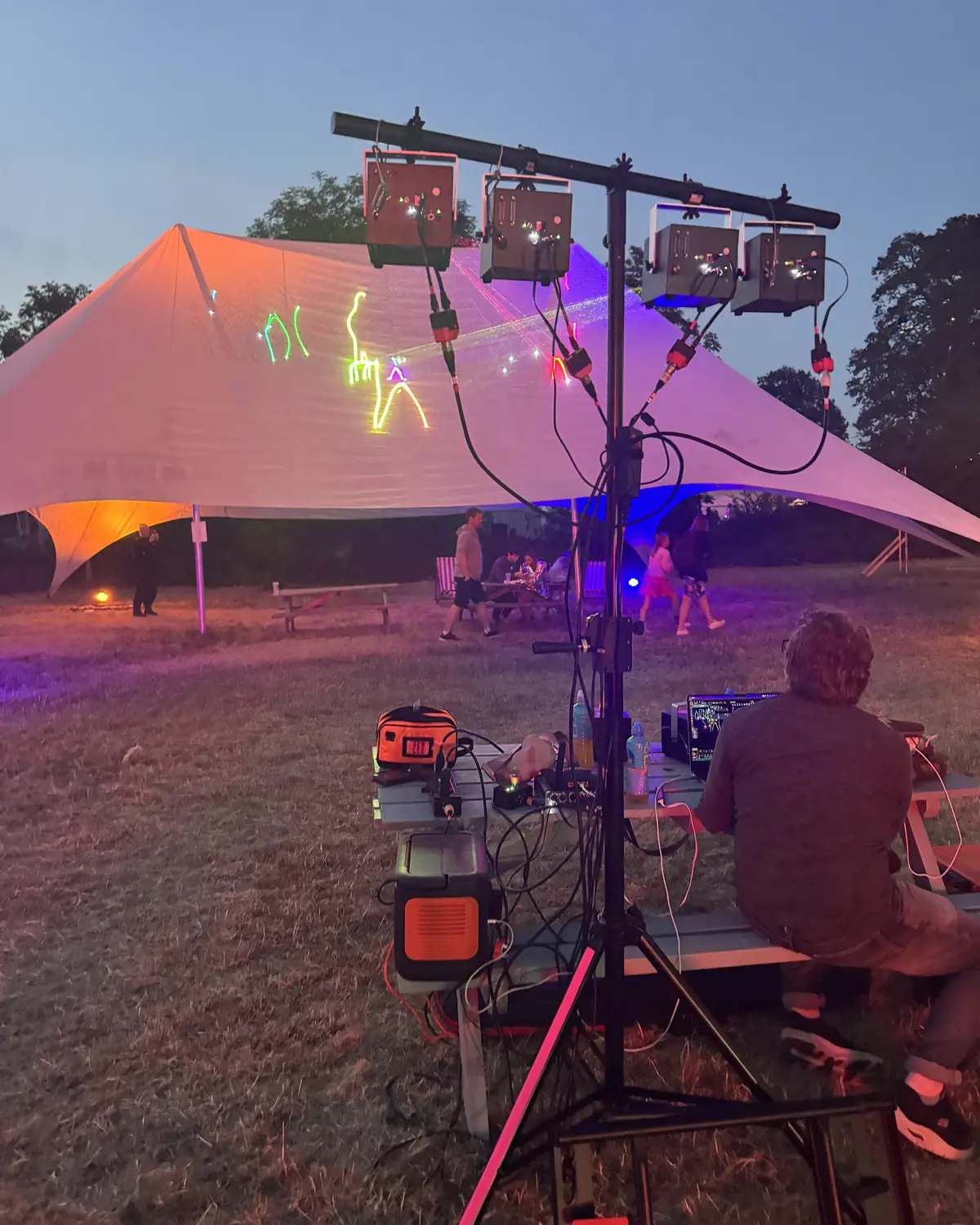
Lasertag ran on all 3 evenings. Free, no booking, ages 7 and up, 10 players a game, on gear the organiser had 3D printed himself. There was a queue every night, and you stood in it behind children and people in their 40s in roughly equal number. That's a fair description of the whole event.
Elsewhere, Karina Townsend performed on a set of DIY modular bagpipes with a laser show wired to respond to the sound. The bagpipes were built from rubber gloves, domestic water piping, bin bag material and a spread of tapes from self-amalgamating to insulating. The listing promised wobbly oscillations. It delivered.
Rockets
On the Sunday at 9 in the evening, a man called James test fired a small hybrid rocket motor named Banshee in the Flame village. It runs on oxygen with an acrylic fuel grain, which means the fuel is transparent. You can watch the flame front move inside the motor while it burns. The schedule entry had a one word warning at the end: noisy.
That was the demo. The talk that stuck with me was Danny Roberts on high-power rocketry done cheaply, which was really a talk about running an under-funded university rocketry society against teams with more than 10 times the budget. Materials, makerspaces, DIY altimeters, and the very specific anxiety of waiting to see whether your ejection charge fires at apogee. Emily Selwood also gave a funny one on the ways humans have proposed getting to space, including the ones that only work if you ignore safety. Or the rest of humanity.
Satellites
AMSAT-UK, the British Amateur Television Club and the UK Microwave Group ran a joint village. They did live demonstrations of tracking and working an amateur radio cubesat as it went over. They also worked a pass of the International Space Station, using the amateur radio voice repeater on board. I watched that from a folding chair.
Andrew Lindsay gave a talk about assembling and testing LoRa payloads for satellites. He's built and tested 10 of them. 6 are in orbit. Jeffrey Roe ran a workshop where you build your own ground station on TinyGS, a community-run mesh of receivers around the world picking up LoRa satellites and weather probes on cheap modules.
You can go from never having thought about it to receiving data from space in an afternoon, in a tent, for the price of the parts. That's the actual point of the village.
Locks
TOOOL and friends ran a Lock Picking Village with no set times at all. You drop in, someone hands you a lock and a pick, and someone else teaches you. Beginners and experts, the listing said. In practice you watch a lot of people find out, for the first time, that a lock is a mechanism. Not a fact.
The best thing I saw on the subject was Etienne Naude's talk on his open source lock picking robot, which he built to make locks more secure rather than less. His argument is about master keys. They're used almost everywhere, including on nearly every suitcase, and they carry real structural weaknesses. His machine pushes a series of wires through a custom 3D printed steel key blank to spoof whatever bitting the lock wants. The build is open.
Cars
Hacky Racers have a track in front of Null Sector. They race on it most of the weekend.
The series started in 2018, after some of the founders saw the Power Racing Series in the US and decided the UK needed its own. It's a genuinely registered Motorsport UK club, non-contact, running cheap DIY electric vehicles that people build over the winter. There were races most hours across all 3 days, then the final and the medals on the Sunday at 5, with the audience voting for a favourite. The listing calls the entrants bonkers DIY karts and the track a DIY track. That's the right amount of self-awareness.
Somewhere in the same family of object there was a small pink Lamborghini, which I filmed, because of course I did. It ended up parked at the Brighton Consulate, where Jim Purbrick played a set from it as the sun went down. Generative ambient soundscapes underneath recordings of the last generations of people who'll remember glaciers. Performed from a tiny pink supercar. I can't describe that in a way that makes it sound less strange. I don't think it should.
For contrast, James Hervey-Bathurst, who owns Eastnor, drove his 1928 Foden 6 ton steam wagon onto the site on the Saturday morning and talked about restoring it. So the range ran from a kart made of scrap and a battery to a 98 year old steam lorry. With a pink Lamborghini playing ambient music in the middle.
The thing they left behind
At the 2024 edition, which I was also at, somebody left 2 radioactive sources in the swap shop.
The swap shop is what it sounds like. You leave things you don't want and you take things you do. These were Danish measuring ionisation chambers, built by a company called Elektronikcentralen, and their job was calibrating smoke detectors. A technician fed sample smoke through a port in the middle and checked the detector noticed. They contain Americium-241, the same alpha emitter as the detector in your hallway, but substantially more of it.
Someone called Tryst, who works in civil nuclear and happened to be on site, worked out what they were. He sealed them in plastic bags and locked them in the back of his truck. Then he posted an appeal asking whether anyone else had taken one from the swap shop, and offering 3 ways to reach him: a DM, Telegram, or DECT 8797.
That's the campsite phone network from earlier, being used to trace radioactive material across a field.
It resolved within the day. The person who'd brought them confirmed there had only ever been 2, and both were accounted for. What I keep thinking about is the gap before that, because he couldn't prove it at the time and said so publicly. Someone pointed out there might be more than 2. He didn't sleep well.
He came back this year with a talk called "The Orphan Source Incident". An orphan source is what the name implies: radioactive material that's fallen out of the chain of custody meant to account for it. Intact, these ones aren't especially dangerous. The problem is they're easy to take apart, and an ingested alpha emitter is a completely different problem from one sitting inside a sealed housing. So they have to be kept safe. They have to be accounted for.
The ending is the part that stayed with me. Normally they'd have gone back to their Danish manufacturer for disposal. Post-Brexit regulatory changes meant that route no longer worked cleanly, so they ended up in a grey area where nobody can straightforwardly take them. He finished a talk about a radiological incident by asking the room whether anyone had ideas. I don't think he was joking.
He also built the whole thing so that no blame attaches to anyone involved. Nobody's named except the manufacturer and the regulators, and the route the sources took from industry to a field in Herefordshire is deliberately left vague. That isn't squeamishness. The reasoning is explicit: identify and punish the person who did this, and the next person in that position doesn't come forward. Then the next set of sources goes somewhere far worse than a campsite that happens to have a nuclear engineer standing in it.
You can watch it. It's worth 30 minutes: The Orphan Source Incident. Hackaday wrote up the follow-up too.
The bit I was there for, allegedly
I was on Stage A on the Friday at 17:40, for 22 minutes, on how North Korean IT workers try to get themselves hired into your company.
The short version: some time ago I opened a few remote roles and was buried in applications. Thousands of them. After a while I noticed how many looked like each other, so I stopped hiring for an afternoon and started digging. Greenscreen setups and computer vision to get through identity verification. Laptop mules on US soil, so the machine you shipped sits exactly where you expect it to sit while somebody else drives it. VPNs and KVMs of varying quality doing the driving. The investigation this fed into ended up contributing to 29 property searches and 5 arrests.
It's here if you want it: North Korean agent looking for a job.
We also had a village. There was a venue on the official EMF schedule called the cside security village, which is a sentence I enjoyed reading more than I expected to. We ran a scavenger hunt across the site, "Find the Creatures Attacking the Web": 4 mythical creatures, each standing in for a different client-side attack. Find all 4 and you went into a raffle for a retro handheld running Linux. Marc, Jovian and Aarnav did most of the actual work.
That's about 22 minutes of stage time and a tent. I spent the other 3 days walking around, which is the part I'd go back for.
Where I landed
I went in expecting to enjoy the spectacle. I came out thinking about the norms underneath it.
The through line at EMF is that you open the broken thing and show people the inside. Dimitri opens up a flame unit that failed and walks a crowd through his own mistakes. Tryst gives a talk about a radiological incident on a campsite and builds it so that nobody involved gets identified. The whole schedule is people describing, in detail, the parts that didn't work.
That's the same norm the security industry claims to run on and mostly doesn't. Disclosure only works if reporting isn't punished. Everyone agrees with that as a principle. Then a company finds something embarrassing about itself, and the incentive is to say nothing, ever, to anyone. Which is how the next 50 companies get to learn the same lesson individually and expensively.
I don't think you get a culture like that from a code of conduct. You get it from 3,000 people who have all built something that didn't work the first time, standing in the same field, with nothing much to prove to each other.
The talk was my excuse to go. Being there was the point.
See you in 2028.