Simon WijckmansSimon W.
← Writing

How to handle hair loss as a male in 2026

A while back I went down the hair loss rabbit hole properly. Not a quick search. More like the way I research anything I actually care about: too many tabs, too many evenings, and a growing suspicion that most of the people selling me things knew less than they were letting on.

Spend an hour online and you'll find shampoos, serums, rollers, supplements, oils, peptides, laser caps, influencers, and clinics all telling you they have the answer. They don't. There's no silver bullet here, and a lot of what's on offer is solving for the wrong problem entirely.

Before anything else: I'm not a doctor and this isn't medical advice. It's what I learned reading, and I've tried to be honest about where the evidence is strong and where it isn't. Anything below that involves a prescription involves a real doctor. Go get your own.

If you want to do something useful about hair loss, start by working out what type you actually have. Everything else is guessing, and the guessing is expensive.

It isn't one thing

People talk about balding like it's one condition. It isn't.

Genetics and androgenetic alopecia is one category. Stress-induced shedding, telogen effluvium, is another. Autoimmune attacks on the follicle, alopecia areata, is a third. Iron deficiency and other boring nutritional problems sit somewhere else again. Different mechanisms, different timelines, different fixes. Copying whatever worked for a stranger online only works if you happen to have his condition.

Genetics

This is the one most people mean, whether they know the word or not.

An enzyme converts testosterone into DHT, DHT binds receptors in susceptible follicles, and each hair cycle comes back a little finer and shorter until it stops being a real hair. That shrinking is called miniaturization, and it's the outcome, not the cause. How susceptible you are is mostly inherited, somewhere between 60 and 80 percent by most estimates.

There's an old rule of thumb about looking at your mother's father, and there's a kernel of truth in it. The androgen receptor gene, the biggest single genetic player here, sits on the X chromosome. You have one X and you got it from your mother, who got one of hers from her father. Your own father, by definition, handed you a Y and no X at all. That's where the folklore comes from.

But treat it as a signal, not a prophecy. Your mother's two X chromosomes shuffle before she passes one on, so the X you ended up with is only about half your grandfather's. And of the 600-odd genetic locations mapped so far, only 26 sit on the X. Your father's hairline matters too, and the number of bald relatives on both sides predicts better than any single designated ancestor.

Stress, and why the timing throws people

Telogen effluvium is more real than people think, and more misunderstood.

It's usually triggered by a big physiological hit: a high fever, surgery, a rapid drop in weight, a new medication, a thyroid problem, low iron… Severe psychological stress is on every list too, though the evidence there is softer than most people assume. The annoying part is the delay. It shows up months after the event rather than during it, so people miss the connection and go looking in the wrong place.

A very 2026 version of this: GLP-1 drugs. There's now decent evidence linking semaglutide and tirzepatide to shedding, mostly through the rapid weight loss rather than the drug itself. If you started one and your hair began coming out four months later, that's probably not pattern baldness announcing itself.

A shed usually settles once the trigger is gone. The catch is that it often exposes pattern loss that was already quietly underway, and that part doesn't recover by waiting.

Autoimmune

Then there's the category where your own immune system is the problem.

Alopecia areata is autoimmune: a type of white blood cell attacks the follicle directly. It usually shows up as discrete round patches rather than general thinning, and it's diagnosed by a dermatologist looking at your scalp, not by you squinting at the bathroom floor.

This is also the one area where the last few years genuinely changed things. There are now 3 approved oral drugs for severe alopecia areata, all JAK inhibitors, and a meaningful share of people get most of their hair back on them. Worth being clear about something the headlines confuse constantly: they do nothing for pattern baldness. When you see "FDA approves new hair loss drug" in a news alert, this is almost always what it's about, and it almost certainly isn't about you.

The boring stuff people skip

Iron comes up constantly in hair forums, and it is worth ruling out, because it's cheap to check and easy to fix. Just don't try to diagnose it from how you feel. The symptoms that actually point at low iron are unrelenting fatigue, getting winded on stairs you used to manage, restless legs at night, and, oddly specific but a real tell, craving and crunching ice. Feeling lightheaded or seeing black spots when you stand up too fast is usually a blood pressure dip, not iron.

Worth knowing that nearly all of the iron and hair research is in women, where deficiency is genuinely common. In men it's much rarer, and the evidence that topping up regrows anything is thin even in women. So don't take iron on spec. Get ferritin measured instead, and if a man does turn out to be deficient with no obvious explanation, that's worth chasing down well beyond your hairline.

I think the reason this whole category gets skipped is simple: checking your health is less marketable than buying a branded bottle with the word 'advanced' on it.

DHT and why it's so confusing

The confusing bit is that DHT doesn't treat all hair the same way.

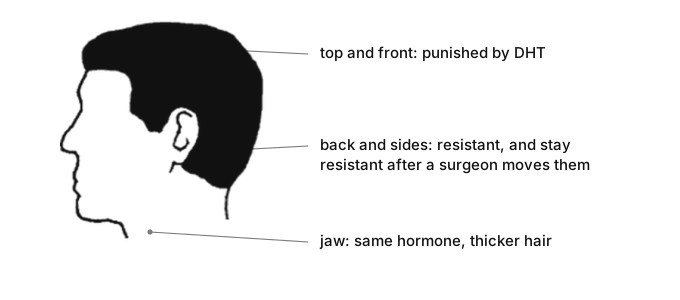
If you're genetically predisposed, the hair on the top and front of your scalp gets punished by it. The rim around the back and sides doesn't. Those follicles are androgen resistant, and they keep that resistance even after a surgeon moves them to the top of your head, which is the entire reason transplants work at all. Meanwhile beard and chest hair respond to the same hormone by getting thicker and darker. So the hormone grows hair in places you may not care about while taking it off the place you do.

Here's the part that took me longest to get. The obvious explanation, that a balding scalp has more DHT machinery, is wrong: beard follicles have more enzyme activity and more receptors, and they thrive. The difference isn't how much signal arrives, it's what the individual follicle does with it. There's no line across your face separating the two behaviours, it's a property baked into each follicle.

DHT matters from puberty onward, which is why this almost never starts in children. But later-age hair loss can still absolutely be DHT-related. Genetics and follicle sensitivity matter far more than calendar age.

What actually has evidence

Here's the fact that reframed all of this for me. The FDA hasn't approved a new drug for pattern hair loss since finasteride in 1997.

Everything else you're being sold sits in one of three other buckets, and I think this distinction is the most useful thing a non-doctor can hand you. Approved means a regulator reviewed it for this specific use. Cleared, which is what laser caps are, is a much lower bar. Off-label means the drug is approved, just not for your hair. Compounded means a pharmacy mixed it and nobody reviewed it at all. You'll be sold products from all four categories in the same afternoon, usually without being told which is which.

Minoxidil

If your follicles are still there but cycling out of the growth phase too early, minoxidil can help hold them in it. The blood flow explanation you hear everywhere is mostly folklore. It's a prodrug, meaning an enzyme in the follicle has to convert it before it does anything, which is part of why some people simply don't respond and never find out why.

The liquid is the drug dissolved in alcohol and propylene glycol, which is why some people end up with an itchy, flaking scalp and blame the drug itself. The foam drops the propylene glycol and is usually the answer there. The bigger mistake is application: it has to land on the scalp, not on your hair. A lot of people think they're using it correctly when they're mostly conditioning their hair with it.

That's part of why low-dose oral minoxidil has taken off, and it's the biggest practical change in this field since 2023. One pill instead of a twice-daily ritual, and there's now a proper international expert consensus behind it. While that's a real shift, it's still a blood pressure drug used off-label, and no regulator has approved it for hair. That's a conversation with a doctor, not a purchase.

Set your expectations either way. Roughly a third of men get regrowth they'd notice in a mirror, and a larger group just gets a slowdown. It's a tap, not a cure. Stop, and the benefit goes within months.

Finasteride and dutasteride

If your loss follows the male pattern, receding temples and a thinning crown over years, then by definition it's androgen driven, and this is where finasteride and dutasteride make sense. They're not trying to create a friendlier environment around the follicle. They're reducing the hormonal pressure that's shrinking it.

They're mostly a hold rather than a restoration, and the trial numbers are good on exactly that: 83% of men on finasteride had no further loss at 2 years, against 28% on placebo. Give it 6 to 12 months before you judge anything, and expect a temporary increase in shedding early on. Dutasteride is the stronger of the two and now tops the 2025 comparative analyses, though in the West it's used off-label.

Topical finasteride is what people reach for when they're nervous about systemic side effects. Be careful with that reasoning. In its own trial it still cut circulating DHT by about 35%, against roughly 56% for the tablet. That's reduced exposure, not zero. And in the US there's no approved topical finasteride at all: everything sold is compounded, which the FDA issued a specific alert about in April 2025 after a run of adverse event reports. That's mostly what the subscription telehealth companies are selling you. They're convenient and they do prescribe real approved drugs, but they make their margin on the compounded ones, and in July 2026 the FTC and 2 states sued the biggest of them.

Now the part I'd want someone to tell me rather than let me find out later.

In 2025 European regulators finished a formal safety review and added suicidal ideation as a recognised side effect of finasteride, and the UK strengthened its warnings again in May 2026 with mandatory patient alert cards. Most reported cases involved the 1mg hair loss dose specifically, not the higher prostate dose. This is not a withdrawal and the drug is still first-line, but any doctor putting you on it should raise it with you, and if your mood changes you stop and you call them.

The sexual side effects are what everyone asks about. In the registration trials around 3.8% of men reported one, against 2.1% on placebo, so the drug-attributable excess is somewhere around 1 or 2 men in 100. You'll also run into "post-finasteride syndrome" within about one search. My honest read is that the evidence is poor in both directions, and I wouldn't let either camp settle it for you.

Two practical things nobody mentions. Finasteride roughly halves your PSA reading, so if you ever get a prostate check your doctor needs to know you're on it, because a normal-looking number can be a genuinely abnormal one. And both drugs can harm a male fetus, so broken tablets and topical residue on pillowcases and towels matter if there's any chance of a pregnancy in the house.

None of this is universal. If your issue is autoimmune, stress-related or nutritional, a DHT blocker isn't an all-purpose answer. It's aimed at a mechanism you don't have.

The maybe pile

PRP, or platelet-rich plasma, is used to improve the environment around the follicle, and some people clearly benefit. If you're going to do it, my view is that you don't do it casually: 3 or 4 sessions about a month apart, then top-ups every 3 to 6 months, indefinitely, because the effect fades when you stop. It's an ongoing cost, not a course you finish. Copper peptides probably do something small for some people, but I won't pretend the proof is solid.

Microneedling turned out more interesting than I expected. The channels dramatically increase how much topical minoxidil gets absorbed, and that's the real reason to bother. But this is also a category where the internet has convinced people that if a little is good, more must be better. That's how people make things worse. Done badly it causes tram-track scarring and pigment changes that don't undo themselves, and going deeper than about a millimetre doesn't help.

Laser caps are the one I feel bad about lumping in with the junk earlier. Several double-blind sham-controlled trials show a real improvement in density. While that's a genuine result, they're cleared rather than approved, the trials are short and mostly manufacturer funded, and nothing tells you which of the 30-odd devices is worth buying.

Rosemary oil deserves a mention because everyone brings it up. The viral evidence is a single 2015 trial that found no difference between it and 2% minoxidil. That's weaker than it sounds: there was no placebo group, so nothing proves either arm beat doing nothing.

When you get to a transplant, treat it seriously

This is the part many people don't want to hear.

Once follicles have properly given up, no drug brings them back, and surgery is the only way to put hair where there is none. But thinning isn't gone. Miniaturised follicles are still alive and are exactly what finasteride and minoxidil act on, so drugs first and surgery later is almost always the right order.

You'll be sold method names: FUE, DHI, sapphire, robotic. Most are the same operation with a different instrument at one step. What actually decides your result isn't on the brochure: how many follicles get damaged during extraction, and who is physically holding the tools.

That last one is where this market gets ugly. A lot of people fly to Turkey, get pushed through a clinic as fast as possible, and are back out the same day. I understand why, it's cheaper and heavily marketed. I still think it's often a bad setup, and in 2026 that's no longer just an opinion about aesthetics. 2 British medical tourists died in Istanbul in 2025, one of those cases investigated as possible reckless homicide, and the international hair restoration society estimates that 15 to 20% of Istanbul clinics aren't properly licensed. While there are genuinely good surgeons in Turkey, you're shopping in a market where that is the failure mode.

Your donor area is also finite, which is why treating the first transplant as a cheap experiment is shortsighted, and why surgeons want you past about 25 with stable loss. A Norwood 2 at 22 can be a Norwood 5 at 35, and you can't design a hairline for a pattern that hasn't finished declaring itself.

Here's what nobody selling you a transplant emphasises: it isn't an exit from the medication. Transplanted follicles are DHT resistant, the native hair around them isn't. Stop finasteride and the transplanted hairline stays while everything behind it keeps receding, and you end up with an island of hair and a gap behind it.

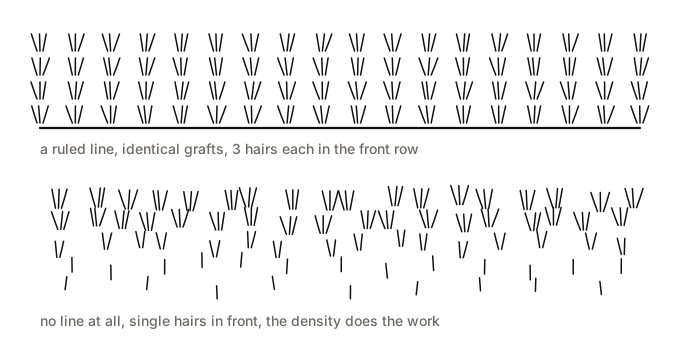
So look for a doctor with a real track record who treats this as craft rather than assembly-line work. And you don't want a result that leaves you looking like a Playmobil character. If the hairline is a straight ruler edge instead of an irregular one, if there's no soft feathered transition, if there are multi-hair grafts sitting in the front row, then congratulations: you paid for permanence and got a costume. A good transplant shouldn't announce itself.

What's actually coming

Clascoterone, a topical that blocks the androgen receptor in the scalp directly, finished phase 3 trials in late 2025 and would be the first genuinely new mechanism in 30 years. It hasn't been filed with the FDA yet, so realistically it's 2027 or 2028 before you could buy it.

Hair cloning, meanwhile, is further away than it was in 2023, not closer. Stemson shut down in December 2024, dNovo has gone quiet, RepliCel delisted, and the Japanese programme people keep citing has slipped to 2027 at the earliest for a first human trial. If someone tells you regenerative hair is 5 years out, hold on to the fact that they've been saying that for a decade.

Where I landed

If you're worried about hair loss, start by figuring out what's actually happening. If it's DHT, look at the treatments that address DHT. If it's a shed, treat whatever caused the shed. If it's autoimmune or nutritional, the answer sits somewhere else entirely and no serum is going to find it for you.

And if the damage is already done, be honest about that too. Sometimes the only durable answer is a well-executed transplant by someone who knows exactly what they're doing.

That's not a fun answer. It's just a more honest one than the rest of the market is willing to give.